The river as passage, death, and continuity
American RustThe river as passage, death, and continuity gives the landscape around Buell a double meaning: it offers a route out while holding the histories and consequences that its characters would rather escape. For Isaac English, its banks are part of a westward itinerary, but the water also recalls his mother’s death, his own near-fatal immersion, and a later decision about whether a body can simply be left to the current. The river carries things onward; it does not make them disappear.
Route Through a Changing Valley
The river first belongs to the practical geography of Isaac’s departure. He plans to reach Pittsburgh by following the railroad tracks beside it, catch a coal train, and continue west by another train toward California. The water marks a corridor through the region, but the railroad—not a boat—is his intended means of escape. His plans are concrete: he has taken four thousand dollars from Henry English and has been considering the journey for a month. The direction west promises distance from Buell, although the route begins in the place and family he is leaving.
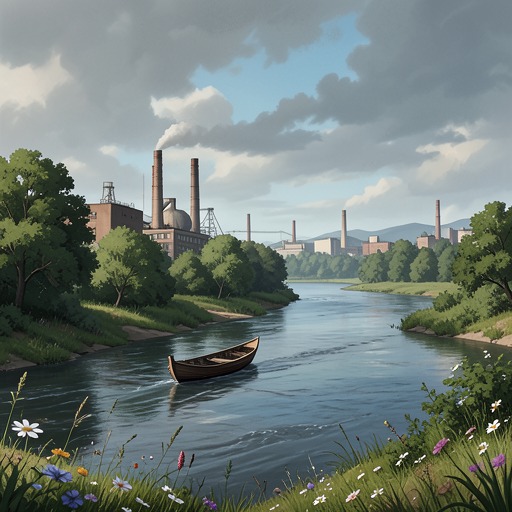
The riverbanks also reveal the economic history from which Isaac hopes to depart. From an overlook, he sees Buell’s closed steel mill, partly dismantled and overtaken by vegetation, with deer and coyote tracks crossing its grounds. The town retains white houses, church steeples, and historic stone buildings, but many downtown properties are boarded or abandoned. Across the Valley, the collapse of steel employment has cost 150,000 jobs, leaving many towns unable to afford basic services. The river runs through a region shaped by industrial work and its disappearance; it is not a neutral backdrop for the choice to leave.
That geography can make escape seem both easy and uncertain. The tracks offer access to freight trains, yet Isaac knows that the shorter trains move too quickly to board safely. On the river, barges and a towboat push coal past him. When their engines recede, the water and forest seem to open onto a landscape that might belong anywhere. But this impression of elsewhere is interrupted by the bluegill in the shallows and the warning that the fish contain mercury and PCBs. The river can suggest an unbounded world while carrying the residue of the one Isaac wants to leave.
Water, Memory, and Survival
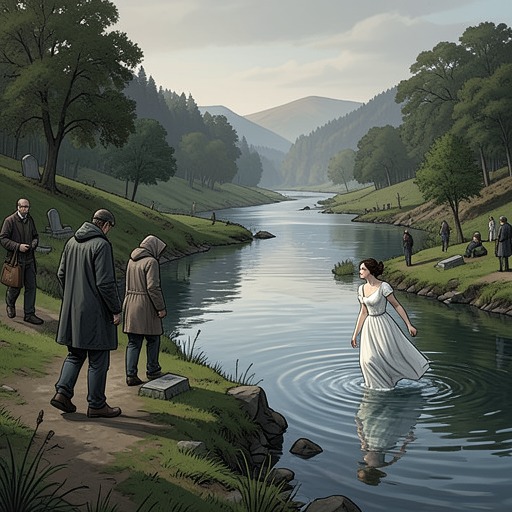
For Isaac, water is bound to a death that remains present five years later. He thinks of his mother entering the river in February, weighed down by rocks in her pockets, and imagines the cold that first hurts and then seems to stop hurting. He connects that experience to his own winter immersion: he had stayed in the water to discover what it felt like, and Billy Poe dragged him out. Isaac described the act as an experiment, but its consequence was that another person had to bring him back from the river.
The memory does not remain in the past as a single, settled account. Isaac turns it over while walking with Poe, moving between the river beneath him, his mother’s death, and his own survival. He imagines cold as a temporary restraint on what lives inside a body, and warmth as the condition in which that life returns. The river’s seasonal change gives the memory a physical measure: the February water was dangerous, while the approaching spring makes it possible to think of survival as something that has continued without being consciously chosen.
The episode also exposes the difference between a planned passage and an irreversible one. Isaac’s westward journey is meant to be an act of departure that can still be reconsidered; the February swim could have ended in death. Poe’s rescue makes their friendship part of the river’s meaning. Water does not save Isaac by itself, and survival is not solitary: another person sees what is happening and pulls him out. Later, when Isaac thinks of his mother’s death and the Swede in relation to the river’s depth, water becomes a measure of how readily a human life can be reduced to what lies beneath the surface.
The River as a Possible Cover
After the factory killing, Isaac and Poe sit beside the water and confront the question of what to do with the body. Poe points out that leaving it in the river will not make the problem vanish: someone could find it, and the body will not simply dissolve from notice. Isaac answers that sinking a body does not take much. The exchange makes the river’s apparent capacity to carry things away morally dangerous. It offers concealment as an imagined solution, but Poe insists that concealment is not the same as erasure.
Isaac recognizes that they cannot simply walk away and pretend the killing is undone. His attention to the body and the river’s depth is thus tied to a dispute about responsibility, not merely to the mechanics of disposal. The current may transport a body, and the water may obscure what happened, but neither action would undo the event. The river becomes a place where the characters test the boundary between physical disappearance and moral escape—and find that the two are not equivalent.
Continuity Beyond a Single Life
At the water’s edge, Isaac’s thoughts widen from the immediate scene to geological and cosmic time. He considers the hills as formations shaped at the edge of the Wisconsin glaciation and measures human life against landscapes that existed long before any individual. The contrast unsettles the idea that a person owns the view or occupies it permanently. A sunset continues beyond the observer; human lives begin and end within a span too brief to grasp against the age of the earth.
That sense of smallness does not leave Isaac with a simple claim that nothing matters. He turns instead toward choice: the facts of mortality and impermanence do not decide what a person makes of them. His thoughts follow the body’s materials beyond death, imagining molecules scattered and reused, borrowed from a planet that in turn belongs to a larger universe. In this account, continuity is material rather than a promise that an individual will return intact. The river’s movement belongs to the same pattern: it carries and changes what enters it, without preserving each thing in its original form.
Watershed and Departure
A quieter image of continuity appears when Lee English and Isaac sit together beneath a blanket on a porch. Isaac follows the water from a nearby stream into another stream, then toward the Ohio and the Mississippi and onward to the Gulf of Mexico and the Atlantic. The thought of connected waterways gives the moment a reach beyond the house and the region. Yet the connection does not undo the distance within the family: Lee has made a life elsewhere, while Isaac is still deciding what leaving and returning might mean.
The river therefore holds together several routes without making them identical. It is the landscape beside the tracks Isaac hopes to ride toward California; the water associated with his mother’s death and Poe’s rescue; a possible hiding place that cannot cancel responsibility; and part of a watershed that carries water beyond any one town or life. Its continuity is not reassurance that loss can be reversed. Rather, it places departure, death, survival, and consequence within a world that continues to move after individual lives have changed or ended.